
I’d never heard of writing coaching. I had a vague idea it might involve someone shouting, “Write more words! Edit faster!” Or perhaps positive affirmations like, “I am strong. I am enough. I can write Chapter Twelve.”
Maybe it would be like sports coaching, but instead of adjusting my golf swing, the coach would tell me to stop overusing the word ‘smiled’ or remind me to stop forcing my themes.
So, when my friend, Whitstable author Peggy Riley, offered me a free session, I thought I’d give it a go. I’d heard so many positive things about her as a creative writing tutor, plus praise for her Hope and Anchor writing workshops. She wanted to get back into coaching after a little time away, and reassured me that it would just be a discussion about my writing and what I hoped to achieve.
Who doesn’t like talking about themselves? And writing is my favourite subject.
It was a sweltering heatwave day, but Peggy settled me into her Blue House writing studio with a chilled Diet Coke while her lovely dog, Louie, kept us company.
It felt just like a friendly chat. Except it wasn’t just a chat.
The conversation kept circling back to useful ideas. I expected advice, but instead it was all about the thoughtful questions. Peggy clearly knows her craft as a writer, but she’s also wonderfully empathetic.
It wasn’t anything like a therapy session, but Peggy mentioned that life stuff would probably come up. I suppose that’s natural because everything we write touches on the themes in our lives, and because life has a habit of getting in the way of our writing.
It’s an unusual thing to have a focused conversation about writing and what it means to you. We covered an awful lot in an hour: my goals, sticking points, and how to build a productive writing life around everything else that’s going on. I have a nearly finished second draft of a novel, and a nagging worry that I might never quite get it finished.
Peggy was such a sympathetic, nurturing listener that I soon found myself sharing the Big Problem.
She probably wasn’t expecting the conversation to turn this way. Neither was I. I don’t usually admit my problem to anyone. I confessed my secret fear. My novel might never be finished because of glue.
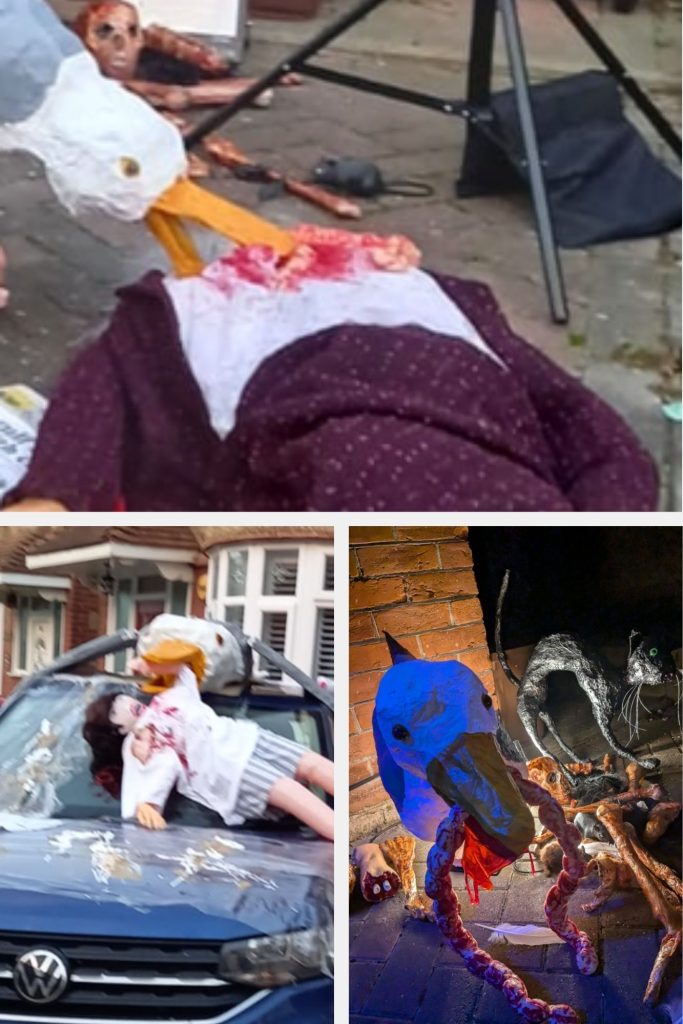
You see it takes a ridiculously long time to glue ten layers of paper to a cardboard frame, and I have an unhealthy desire to outdo my neighbour at number 27. My book, I explained, was in serious danger of being abandoned in favour of building a shark the size of a car, and possibly an octopus made from pool noodles.
I love Halloween and I love papier-mâché. Every year my neighbours and I go completely over the top to create Scare Road in Whitstable. I always invent an ambitious new display. Last year it was Peter Cushing’s Frankenstein, complete with an interactive science lab. The year before it was giant killer seagulls.
I normally start building in August and spend every spare weekend covered in newspaper, glue and paint. But this year I’ve reached the final hurdle with my novel. Weekends are my best writing time… and also my best monster-making time.
Peggy didn’t look fazed by this crazy novel-versus-glue dilemma.
Instead, she helped me solve it.
I really respected the fact that she didn’t dismiss my need to build a ten-foot shark. She understood that it mattered to me. Instead, together we worked out a realistic plan. We calculated how many words I needed to edit each week to finish my third draft by the end of October, and then looked at where the shark could fit around that.
As we talked, I realised that I had a bit of an overdoing-Halloween problem. I make plans so big that they take over my life. It’s enormous fun, but gore / life balance matters. Rather than starting in August as usual, I decided to keep September largely for writing, and save the monster-building for weekends in October. Better still, Peggy suggested turning it into a Halloween sea monster building party, complete with wine, and even offered to come and help. How many writing coaches would be that hands-on?
Peggy also had a perfect knack of letting me explore an idea for a while, then gently steering me back to what mattered. At one point I found myself earnestly debating whether a giant shark or a mythical sea monster would be a bigger crowd-pleaser for ten-year-olds. Somehow, a few minutes later, we were back talking about novel deadlines and realistic writing goals. I still don’t quite know how she did that. My husband would love to learn this technique.
Somewhere during the conversation I realised something else too. I’d spent half an hour talking about my frustration at not finishing my novel, yet I’d also described everything else I’d created recently. A new edition of Cats Don’t Fetch. Work on StoryPlanner. Organising the Writers of Whitstable anthology and new Story Craft sessions. Proofreading my mum’s novel. Squeezing in a job as well.
Perhaps I wasn’t failing to finish things. Maybe I was simply trying to finish too many wonderful things at once? I realised that my creativity had quite a few outlets outside writing, and I decided that was okay.
My Halloween obsession turned out to be the sea monster dragon standing between me and finishing my novel. Your dragon might be work, young children, video games, caring responsibilities, procrastination, or simply self-doubt. Whatever it is, I think writing coaching is about working with your life as it is, not wishing it were different. However bonkers the thing getting in the way turns out to be, having another writer ask the right questions can help you untangle it.
The coaching didn’t just help me set a realistic goal. It gave me a better understanding of how my creativity works. Peggy also made an observation I’d never considered before: that my delight in making wildly over-the-top Halloween creations probably isn’t separate from my novel writing at all. It’s there in the themes of my book. My novel even has a monsters subplot, but somehow I’d managed to write it without spotting the link.
I left feeling much more confident that I can finish my novel by October 31st without giving up the Halloween madness that makes me happy. That, I think, is what surprised me most about writing coaching. It wasn’t really about learning how to write. It was about understanding how I write and making my writing fit the life I have.
If you’re feeling a little stuck, or simply want someone to help you untangle your own writing dragon, I’d thoroughly recommend a coaching session with Peggy. She also offers accountability check-ins, which I’m hoping will help keep me on track as my Halloween deadline draws closer.
You can find details of Peggy’s writing coaching services here, and I’d also recommend taking a look at her Hope and Anchor writing workshops, If you’d like a flavour of her approach, her Substack is full of thoughtful posts, writing prompts and encouragement for writers.
Thanks, Peggy!