We Are What We Speak – Foreign Languages in my novel The Fortune Teller’s Factotum

Nick Sweeney

I speak a few foreign languages, partly through the circumstances of living in different countries. I go to France fairly often, but I sometimes think my upkeep of French is nostalgic, as it was the first practical foreign language I studied; I learned Gaelic at primary school in Dublin, and took to it and liked it, but being nine years old, I was not engaged with it once I was living in London. French opened up a world I had sensed perhaps from early exposure to foreign films or films set in foreign parts, but didn’t see clearly until I was able to name things in that world.

I was a classic latchkey kid, and spent a lot of my childhood wagging off school and watching black and white films in our empty flat, at least some of them set in locations other than the UK – at least, that’s partly where I locate my fascination with ‘the foreign’.

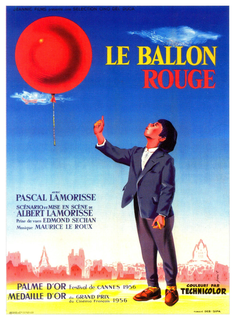
The first foreign film I remember is Albert Lamorisse’s 34-minute Le Rouge Ballon, in which a boy follows his errant balloon around the streets of Paris’ Menilmontant district. Ironically, it is more or less silent, but it instilled in me a wish to go to Paris, and live there, which I managed in the early 80s.

           Language for me is primarily about speaking and listening; ice cream vendors don’t want you to write down your request for a vanilla cone using perfect spelling and grammar, nor will they write back that they only have chocolate or strawberry. I can write in French, Turkish and Polish, and also use the intriguing Cyrillic handwriting occasioned by learning Bulgarian for a year, but I wouldn’t attempt to write a novel in any of those languages.

           English is, pardon the expression, my lingua franca for all my creative work. If you set your work, as I often do, in foreign countries, you have to decide how to put over on the page the fact that a character may speak in an accent. My rule is to do it as minimally as possible. Nobody wants to read excruciating pages of ah am, ow yoo zey, oon vrai Parisiann, nesspa… Point out to readers that a character has certain origins, and perhaps a few quirky phrases that accompany them, but for the love and sake of intelligibility, allow readers the leeway to work out how they perceive and process the character’s persona. Anything more is at best patronising. Years ago a member of a writers’ group I was in had set his novel in Greece, so nearly everybody in the book kept saying the few Greek phrases most tourists garner – lots of kalimera for good day, for example, and parakalo for thank you, when the ‘rules’ of writing, like them or not, dictate that every word in a novel should advance the story, even in dialogue – especially in dialogue. It was showing off, but not even particularly skilled, or useful, showing off.

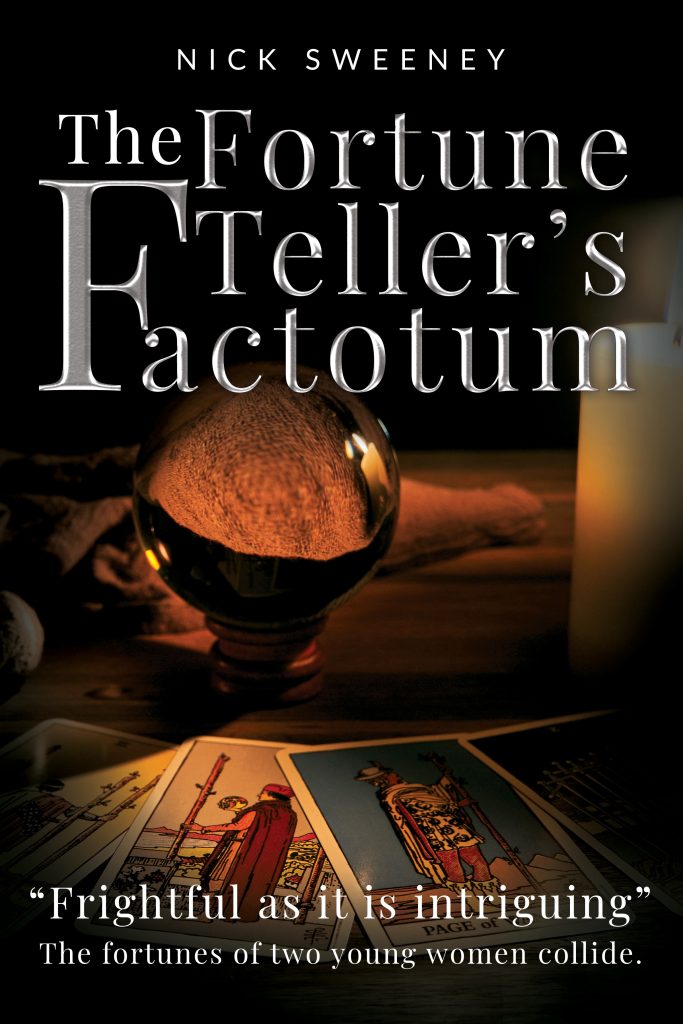
           There isn’t too much to engage the foreign language spotter in my 2023 novel The Fortune Teller’s Factotum, set in Pennsylvania. Main character Ashley Hyde describes the fortune teller in the following way:

           Her accent sounded almost English.

And then, perhaps 20 minutes later, after being spooked by the low lights and ‘exotic’ décor of the fortune teller’s setting, reflects that she:

…no longer sounded English to Ashley, more like somebody who had acquired English, correctly and painstakingly.

At this point we have to take Ashley’s word for it. It is revealed only in the second part of the book that the character is in fact as through-and-through an American as any American can be, but has lived overseas for over 20 years. We learn that in her twenties she abandoned her life studying at Paris’ Sorbonne on a whim and followed a Gypsy guitar player to live in the rather sinister Romania of the Ceaucescu regime. She explains:

“I never forgot English. Of course not, though I did hear of people who claimed they’d lost their native languages entirely. But I hardly spoke it. There was nobody to speak it to. Now the whole world speaks English. Badly. But not in those times. And not among the Gypsies, hardly even now.”

One of the few foreign words I use in the novel is mahala, a word I knew from Turkish to mean ‘area of a town’ but which comes from an Arabic word for settling or occupying. It corresponds to the rather un-British ‘quarter’, which goes back to the Romans splitting towns into four by criss-crossing two main roads. In Romanian, as Judith explains, it now means ‘the Gypsy Quarter’ – used neutrally, I imagine, unless its users want it to sound pejorative. A few years after I lived in Turkey, I learned Romanian for a year – the most difficult language I have set about learning – and was pleased to see plenty of words from languages I knew; the Turkish words were from the proximity of borders in the Balkans, and trade. Being a romance language, Romanian also has a lexicon familiar to any speaker of French, Italian and Spanish (but of course lots of faux amis to watch out for too). I used the word mahala in The Fortune Teller’s Factotum as a single instance of the mark Romania and the Gypsies’ own language had left on the runaway and homecomer, a small sign that just because she was away from it, and her now lost Gypsy beau, she still respected it, and found its words in her head to use.

It helps to know a language before confidently committing it to your writing, but a bit of research (and a good editor) may help if you don’t. I was amused to see this in Michael Dregni’s book about one of my heroes, Django Reinhardt:

We banged on the door, and a voice said, “Entrée!”

Were they offering an appetizer, or inviting them to come in, a reader might wonder. The word entrez might have helped.

I don’t give much credence to the much-touted ‘authenticity’ of novels; it’s an enjoyable but artificial way to tell a story. However, there are ways to make a novel less patently ‘inauthentic’, and paying close attention to people’s languages whether native or acquired, a large part of what makes them who they are, is just one of them.

Read more about The Fortune Teller’s Factoum on my website: https://www.nicksweeneywriting.com/the-fortune-tellers-factotum.html

Available from Amazon HERE.

Writing my second novel – ‘The Canterbury Stink’

By Duarte Figueria

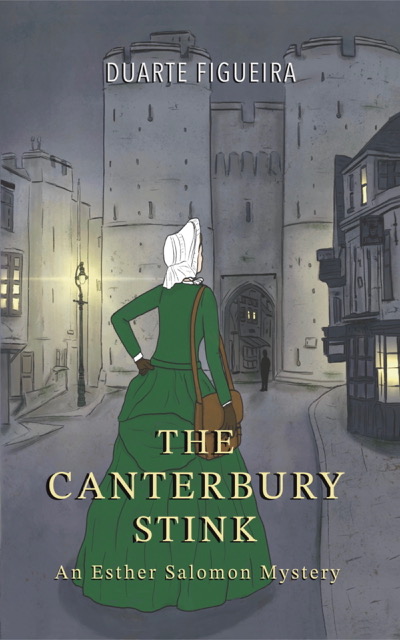
‘The Canterbury Stink’ was a conscious attempt to develop as a writer by constructing a crime plot that would carry and entertain a reader over 100,000 words. The novel is set in a fetid, cholera-ridden and corrupt 19th century Canterbury where a woman detective seeks to solve a murder everyone else would rather forget. Luckily, there are also a few laughs.

        My first book, ‘The Ginger Flic Casebook’ had linked together about a dozen short story ‘cases’ in the style of a Sherlock Holmes collection and was deliberately surreal and madcap. You can fly by the seat of your pants for that, but does that work for a single long tale? Was I a ‘plotter’ or ‘pantser’? My answer was definitely plotter. I had to have the structure in my head and on paper, even if only to diverge from it. It’s far too long a trek to travel without a map.

        But I discovered that with such a map two things can occur. First, there will be at least one point at which you are becalmed and then panic as you gradually slip under the swamp water. Somewhere inside your writing self, you’ve lost confidence in the map. For me, it happened when I finally brought the three main characters together – detective Esther Salomon, philosopher Karl Marx and sensation novelist Amy Price. Previously, they had each separately displayed their point of view – now one of them had to lead the reader through each chapter. Ahh, hadn’t thought of that.

        I recall that Andrew Miller, discussing his new novel ‘Land in Winter’ at the Faversham Literary Festival this year, talked about letting writing ‘unspool’ itself until you start looking for an ‘escape hatch’ to finish the thing. Clearly he is a pantser. And it’s true that your trusty guide can suddenly turn from security blanket to a lead weight. You also need to be able to act on instinct to move on. So be a bit of a ‘pantser’.

        Second, the bloody map will have mistakes in it, points at which you will discover that some event could not have occurred when you’d planned it, or when a character turns out to be very different to what you’d imagined. So a key landmark will turn into a mirage. Of course it would. After all, no one has ever been to that place you are creating before. So scribble the revised fiction on the map and keep going.

        It is a truism that with each novel a writer reveals him/herself, and most of all to themselves. I discovered that I love the past and the way its tendrils connect to the present. The fact that water and its treatment are a real problem in Britain today has its roots in decisions about sewerage treatment made in the 19th century. As I write these words, people in Chestfield are experiencing the same disgust at the air stink they are breathing in as Canterbury folk did a century and a half ago. Though hopefully today they will not topple over with typhoid or cholera from drinking polluted water.

        Why write this novel at all? Firstly, the Victorian age lives with us daily, in architecture, art and material life. To my mind, we are like Anglo-Saxon peasants living in the ruins of Roman London, reusing its city wall stones for their own purposes and wondering how the Romans ever built their amazing world. For much of the social progress we take for granted began in Victorian times, in greater democracy, in working-class political organisation and in the women’s movement, as well as in the engineering infrastructure that makes our lives easier. But in historical terms, that was only minutes ago, which reminds us that it could all be taken away.

        Which brings me to Marxism and historical materialism. The germ of the novel was discovering that Karl Marx visited Margate in March 1866 to be treated for boils on his nether regions. Yet for some reason best known to himself he decided one day to walk the 17 miles to Canterbury and stay there overnight. He must have been in agony. Wondering why he did so ended up with investigation of his personal life, discovering about Canterbury’s colourful Victorian past, researching financial scandals (that then as now suffer no punishment) and reading a slew of 19th century ‘sensation’ and crime novels. At the end of it, I certainly saw where Marx was coming from in his analysis of society. The real point is that every writer needs that initial spark of interest to get the project rolling.

        At the end of it I’m very conscious the novel is imperfect in many ways. But equally sure it’s a step forward for me as a writer. And I’m very grateful to WOW members for their help on that journey. And in particular to Lin White for her excellent comments, editing and ebook and paperback formatting assistance.

Available now: The Canterbury Stink by Duarte Figueira – out in paperback and on Kindle. Find it here.

Posthumous novel by WoW’s R.J. “Harry” Harrison published

Much-loved WoW member, Harry Harrison, died in November 2023. He’d workshopped his novel, ‘The Welfare’ through the group’s meetings for well over a year. We were close to reading the ending, and looking forward to seeing how the story played out. It was a massive shock when Harry was diagnosed with leukaemia and told it was untreatable.
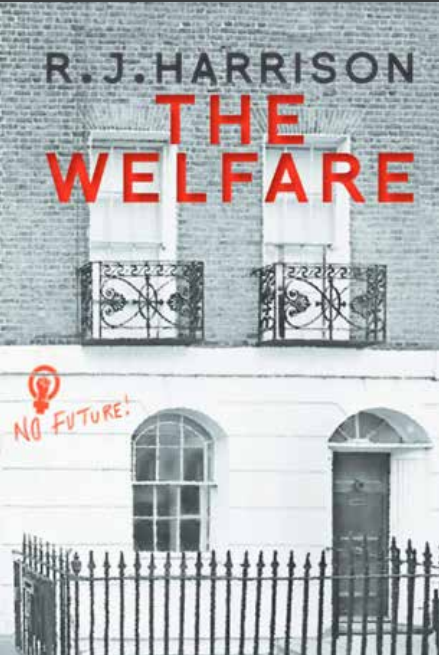
Harry had just a few months left, but wanted his book finished and published. He couldn’t manage that himself, and WoW members wanted to help. So, despite being extremely unwell, Harry put together a plan. It was a testament to his determination and character that, despite his ill health, he created a thoughtful and detailed plan of action to make it as easy as possible for the group to finish his book. We all agreed to help because the book was so good it deserved to be enjoyed by a wider readership. 

Harry determined that Richard, who has a wonderful writing style, similar to his own, would finish the last two chapters based on his notes. Duarte and Nick would edit the manuscript. Lin, of Coinlea Publishing Support, would proofread the manuscript. He gave me contact details for a publisher and friends with knowledge of the business, plus people who might help promote the book. He had ideas for the book’s cover, and as a keen member of Jericho Writers he asked on the forums how to improve the novel’s blurb. As his health was failing, he even dictated words from his hospital bed. This book meant so much to Harry.

The novel draws on Harry’s 50-year career in social work. The Welfare is set against the backdrop of 1970s London, and follows Jack Wilson, a young social worker who leaves behind his rural upbringing to navigate the challenges of life in the capital. Jack faces complex clients, office politics, and a romance that changes everything. The story is told with warmth and honesty. It’s an insightful look at the challenges and triumphs of social work, but also a poignant and entertaining story. WoW are delighted that this story will now gain a wider readership.

Thanks to Richard White, Duarte Figueira, Nick Sweeney and Lin White, for devoting so much time and effort to making this happen. I know it was a lot of work but it was certainly a wonderful way to honour a friend.

The book is available to order from your local or online bookshop. You can buy The Welfare HERE.

WoW Story Craft session 1 – Problems and goals

Writers of Whitstable has launched a new Story Craft group. This discussion group will focus on various aspects of writing a novel, with a ‘homework’ exercise before each meeting. The exercises involve looking at published novels and encouraging writers to compare them with their own works-in-progress. The first meeting focused on problems, stakes, and goals—and how these are introduced in a story. Here are a few thoughts on the subject.

Doesn’t this story conflict come naturally?

Absolutely! It would be hard to set up a story without a character hitting a problem, and with no story stakes at all. A character will often have some goal to strive for, or the goal might be to preserve the status quo.

So you’ve written a story with a problem. But are the problems big enough? Do they interest the reader or make them care?  Is it a problem that can leave a lasting impact on the character’s life?

Internal vs external problems

It’s also good to consider whether your story offers the right mix of external plot problems and internal emotional problems. This mix will vary based on the genre. Some books are mostly action, adventure, and exciting plot, others are all emotional entanglements, with stirring highs and lows for the main character. Some books are a mix of the two. When you sit down to write do you have an image of your reader, and an awareness of the type of book they are expecting?

In my genre, contemporary women’s fiction, a plot problem is typically caused by an internal character problem or flaw. I love to see characters who cause their own downfall, this adds a layer of complexity to the story. Some characters seem to ‘get in their own way’ of accomplishing a goal. The central character in ‘Eleanor Oliphant Is Completely Fine’ longs for a relationship with a local musician, but everything about her awkwardness and sad coping mechanisms make the goal impossible. I think this is a great example of an internal problem.

What is an ‘Inciting Incident’?

An ‘inciting incident’ is closely linked to story problems. An ‘inciting incident’ is a key scene that hooks a reader into the story. It’s the spark that starts the story’s journey. It usually introduces the main problem or challenge a character must overcome.

In Story Craft sessions we’re going to look at a wide range of successful books. I’m fascinated to see what we come up with through this research. Is it good to have one big dramatic inciting incident? Or does it work to have a more subtle story set-up? In the hugely popular Hunger Games book there’s a big scene to set up the story problem. The central character faces one unexpected moment and she chooses to undertake a life or death challenge.

In some books the story set up is more gradual. There might be lots of little problems that lead to a much more subtle inciting incident. Think Mr Darcy’s first encounter with Elizabeth Bennett in Pride and Prejudice.

Different genres have different conventions for setting up problems at the start. It’s always useful to read and study books that are similar to your work in progress.

The ‘central question’

When we think about the set-up of problems and stakes it’s useful to consider what this means for the reader. The ‘central question’ is connected to the inciting incident. The inciting incident problem should spark a question in the reader’s mind. A big question is raised and the reader needs to care about the answer. The inciting incident might be the live-or-die brutal Hunger Games. The central question is, ‘will Katness survive?’

Problems and goals in the story set-up ideally spark lots of questions – some of which are impossible to answer. The ‘central question’ is, ‘Will Katness survive?’ The answer is… Of course she will! No way is this going to be a book with an unhappy ending! But the set-up has created a multi-layered problem that sparks lots of additional questions too… Who will die in this life and death challenge? What will happen to Katniss’ family now she’s left? How will the brutal game change her? Will the cruel rulers of this land ever change? These are big intriguing questions we can’t answer. We are sure there will be lots of surprises to come.

A test of a great story?

I’m always looking for a hack to judge the strength of story ideas. Maybe this is one? Is the surprise generated by the plot problem some sort of clue to a story’s strength? Is there a direct correlation between the number of questions sparked by the inciting incident, and the quality of a story? I’m not sure! I do know that I’ll love exploring questions like these in our new Story Craft groups.

Want to join WoW and get involved? Get in touch!

Writing and how to stop

By Richard

Dusk – sumptuous – opulence – inured – angst – whisper – nemesis – tryst. I liked the sound of words when I was a little boy. Of course I did not know what they all meant. My father understood, he was a word man, a publisher, he smiled and said nostalgically, “Ah yes…” Perhaps he thought I would follow him, but no…

I did not have a writing life. I had ideas and coined phrases about people when I was in my early 20’s, but they did not blossom. After sitting in front of my typewriter for hours, I just got up and went for walks. I saw a lot of Chelsea and Fulham, and had many new ideas. But I soon decided that I was happier not trying.

Sculptor? Photographer? I ended up making documentary films, where there was always writing needed, starting with a proposal, then through ideas to narration and drama sequences. I used to search for new writers. They were nice people and I made a few friends but most of their results were disappointing. Then economy spoke. Producers don’t want to spend money, and if they can hire one person instead of two, they’ll come in under budget.

“The script is part of the job, old chap. You want to work, don’t you?” So my fingers settled on the keyboard.

“Pretty good, old chap. Got another one for you.” So I was working, but with other dreams. Fiction is about people, it gets personal, and that’s what I wanted.

“You’ll be up against it, old chap. Everybody’s a writer these days.”

“So are they all lonely?”

“Writing is something you do on your own. Get used to it. Got another one for you about computers…”

It wasn’t until I was forty-something, in the Michoacan Hills in Mexico, living in an American ex-pat community, sharing a printer with a woman novelist who used to be a male painter, that I discovered letters. I would write 15 pages to people I used to know in London. I couldn’t stop. Others got 20 pages. I hoped they weren’t busy when my letters arrived. It took time, so I told myself I could always just not do it, then I found I could stop. It was a revelation, like recovery from an addiction. For years I was free.

Coming home from another life in the Caribbean I felt dry, cold and empty. I needed something to do while the film industry came to terms with my desertion and offered me jobs again. I did a short course at the City Lit. I was not sure what I was getting from it, but I met two lady poets who ran a retreat for writers near Perpignan in the French Midi. It was not until I got to Paziols that I learned that the writers were all women—nine of them—with me the only man. In the afternoons we sat around a rough wooden table in a French Farmhouse and read aloud extracts chosen by the two poets.

Overcoming my intimidation, it fell to me to read a verse from Midsummer by Derek Walcott. It turned me inside out. Only I knew that the poem was describing Port of Spain, Trinidad, that place I had lived in for two years before returning to London leaving behind almost everything I knew and loved. That was it for me. I was up at five the next morning, wandering in the half-light with tears streaming, and as soon as I thought I could type without waking the nine women, I started something, I had no idea what. I read a few paragraphs to the two poets.

“You did this since yesterday? What is it going to be?”

“Yes, since teatime actually, and I don’t know what it is.”

“Then I can tell you this will not turn out to be a short essay.”

Nor did it. Seventy pages showed it to be a novel. But I did not know how novels worked. I listened too much to other beginner writers. I got confused. I knew how to stop and I did, for decades.

I have had several ideas for other books, all novels, and mostly with fictional heroes colliding with famous historic figures: Joseph Banks the explorer, President Kennedy. It is as if I have got lost in history searching for my inspiration.

A few years ago Whitstable became my world and at the WhitLit Festival in 2019 I met Lin White standing behind a table covered in short story books, all by Whitstable writers, and soon after that I arrived at the Marine Hotel in Tankerton and met the buoyant bunch calling themselves Writers of Whitstable. Then I wrote stories set in Whitstable. Within a year a runner had reached out from the short story group and I was among five new novelists who broke surface together. It was clearly the moment to think again about my lost work, and with much encouragement from those others I am now cutting new chapters. I can’t wait to finish because I have an idea for another novel, set on the Isle of Sheppey in 1817, to begin after this one.

I still love those beautiful words: Dusk – sumptuous – opulence – inured – angst – pristine…

She left at dusk in sumptuous opulence, inured to the angst that whispered of her nemesis. She was sanguine, she owned the panacea, fear was for others. Thin black clouds severed the pristine blue, and she felt a tiny shiver. There would be hazards, but they had told her she was invincible. This was her first tryst alone. She hesitated…

Perhaps I have a story coming?

Guy’s publishing journey 3

Guy, one of our group members, has been keeping us up to date with news of the book he’s been writing. Here’s the latest instalment.

In April 2020, I was asked via an out of the blue phone call to write a book on Espaliered fruit. I said I’d love to, but it was the wrong time of year (I wanted to start in the Autumn, when I would begin the pruning process and have an idea of what was needed). I asked if there any other titles she was after. She paused and then said yes, running off a long list of things that were needed. The one that caught my attention was Protective Growing. The art of growing things under-cover – or so I thought.

After a chat with the commissioning editor, I was given a year to research, collate, write, edit and re-edit my book. After months of blood sweat, tantrums and tears, speaking with wonderful professionals across many continents (who knew NASA was into gardening in such a big way?) I finished the book. That’s what I thought.

I sent it to the publisher, who passed it to the proofreaders to read it through. A few months later, I got an email with queries and comments. I reread what I had written, re-edited my book; finally, I had finished my book. I sent my corrections back.

How had such an idea of a finished book even come into my head? Next came the diagrams and images. They needed to be better, reshot, sourced at higher resolution, perhaps redrawn. My glossary, image captions and bibliography needed doing, rechecking, confirming.

I went out, reshot, reworked, re-imagined what I was trying to get across, all the while awaiting copyright permissions from contributors who had long since forgotten their part. Some wanted copies of what I had written, to prove it was no fools-errand. Others changed their minds, leaving me with a hole to fill.

I sent it all back to my publisher with a smile. Finished? Not quite.

Now came the cover images and cover info. I needed to make a decision on what images would best capture the true heart of the book. A book about hedges and greenhouses… here, I admittedly didn’t like their colour scheme, but it was non-negotiable. Their theme was across the range. Many, many other writers were busy finalising their books for the launch of a new series of gardening books!

So, after all that, I had finished? Not so fast! My final hurdle came exactly one year and nine months in. The index was still to be done, along with the final proofread, the final check of annotations and redrawn images, the final copyright checks. Phew. Another three solid days of reading, rereading, checking, noting, marking, removing.

Finally, I thought, if I send this back, it is finished. I was scared to. What if I missed something? What if I have made the world’s worst error for all to see? Misspelled a contributor’s name yet again? Got an image backwards? Used the wrong form of species?

I hesitated. Reread. Rechecked. Found more spelling errors. Re-marked. Finally, I sent it to my publisher with the confident boast I had gone through it with a fine-tooth comb!

Sit back, relax, I thought. I really, really, really enjoyed this experience. I was a bit sad. I will never have the same feeling again. Please the gods, let another publisher ask me to write them a book. Maybe I should write a book and send it to publishers, or get an agent, or, or?

Six hours later an email drops into my inbox entitled… “Queries from the proofreader. Please check through and advise accordingly.”

I smiled. The game is afoot!

Writing my novel – The Ginger Flic Casebook

By Duarte Figueira

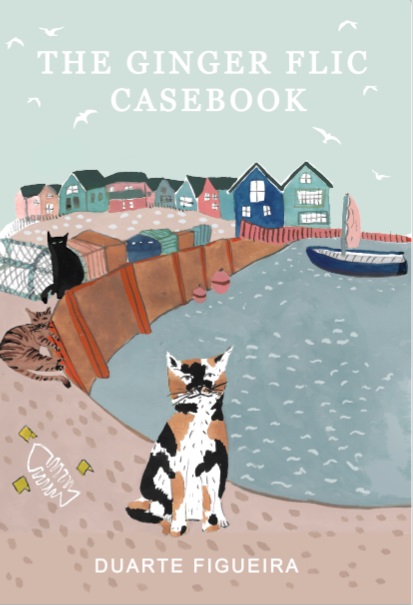
At first the Ginger Flic comedy crime stories, detailing the adventures of a tricolour calico detective cat in Whitstable, were a distraction. From the misery of the pandemic certainly, and also from dealing with my mother’s rapid physical and mental decline in her final year. And absolutely from the hard graft of working on my ‘serious’ novel ‘Palisade’ set in 17th century Jamestown. Unfortunately, in that time and place, nearly everyone dies, usually horribly, so it was the wrong project at the wrong time. 50,000 words in, the over-researched grim tale still refused to take off. The WoW novel group were very kind but also very honest in their comments.

By contrast, the Flic stories had got a laugh from the WoW short story group. Some people even seemed to love them. Gradually, the realisation dawned I had something here and I could link up the stories into a narrative arc. I also realised that by setting it in a fictitious present day Whitstable, I could also write what I knew. A tennis murder is easier to write if you’re a member of the local club. A relentless failure to grow edible vegetables in my allotment provided the spark and locale for another murder plot, pun intended. Being the local neighbourhood watch co-ordinator in my area provided more material for another crazy tale of criminal excess. I sucked my teeth when I wrote the story of a deeply unpleasant local writers’ group, but it seemed to draft itself, your Honour. But no local writers have been hurt in the writing of this novel, I assure you.

I had to take time out from WoW in my mother’s final months and editing the novel was one of the best ways I found to cope. That certainly drove home the adage that writing is re-writing. I thought I had a relatively clean product when I delivered it to Lin (who as well as being a WoW member runs Coinlea Word Services) to copy-edit, but she easily found over 1000 further edits to make. I can’t thank her enough for her thoroughness and helpful advice over and above the call of duty. A friend of my daughter’s who is a designer, Jo Faulkner, offered to do my cover. Magic.

Finally, a few weeks after my mother’s cremation, a change of duties from power of attorney to executor and many more rounds of editing, I thought I was happy with the text. Then the physical proof copy arrived from Amazon, but by then I’d read it so many times I wasn’t seeing the errors any more. Luckily my wife and best reader Denise found yet another load of mistakes in the text. Lin was professionalism personified in that period as she made repeated changes to the paperback PDF and the ebook EPUB files while retaining the formatting. I just apologised a lot for messing her around.

Finally, two months after my mother’s death, I got the novel across the line and online. I’ve wondered if my determination to write something that makes murder comical was a way of dealing with her mortality. I know that coming up with ridiculous plot twists, bad puns and totally improbable cat dialogue made me chuckle a lot in a period with few laughs.

I have very limited expectations of the final product. The average self-published novel sells around 150 copies, so for me it was all about enjoying the writing and getting the novel done. I’ve pledged half the ebook revenues, up to the first 500 copies sold, to AgeUK, who were very helpful in supporting my mother in her final years, and to RSPCA, where Ross, Flic’s side-kick, came from. Flic herself is also a rescue cat, but she arrived as a kitten from the vet, having been found abandoned in a cardboard box under a parked car. She was always going to be proper fictional hero material.

Guy’s publishing journey 2

By Guy

Well, after a year of researching, speaking with experts across the planet, eating and sleeping the subject of ‘Protective Growing’, my book is with the publisher and the editor has very gracefully given me a few days off from it before embarking on the editing phase proper. As somebody who has never written a non-fiction book professionally before, I had no idea what was expected of me. I was given a contract, a writer’s guidelines, a word limit, a deadline and a vague direction to explore. Over the year, several times, I thought I had pretty much finished the book; all it needed was a little polish, 45,000 words down. Each time I would put the book down, go away and do something else; read something or other and try to switch off. Then I would come back refreshed and with new ideas, rewrite chapters, paragraphs and sentences, having realised I hadn’t come close to where it needed to be. In the end, entire chapters have been removed and what I thought to be vitally important bits of information ended up in the ‘stuff deleted’ file. Then came the images. Were they good enough, which to include, which to exclude? 150 for a book about a visual medium is nowhere near enough.

To be fair, I approached this project with an over-inflated ego and an unrealistic view of writing. It wasn’t plain sailing, it wasn’t just a matter of me getting down my knowledge in a grandiose way. The journey was long, was tiring and taught me things about myself I had no idea I had in me. But, it has been a great journey too, despite the 3am starts before heading off to work at 5am for a 9 hr day a hundred miles away, then coming home for another hour or two of notes and reading. I have loved every minute of it. Writing is my passion and I hope I get the opportunity to do it again.

But then again, now I have the next unknown phase of the process. Further ego shaving no doubt, of discussions about content and style. I also have to prepare myself for the reality that after all that sweat, the book may not be accepted for publishing at all.

Writing and publishing

By Lin

I’ve been involved with Writers of Whitstable for several years now. I’ve become a regular member of the novels group, working my way through several novels one chapter at a time, and have encouraged the shorts group through three short story collections so far. It’s been my pleasure to meet writers of all kinds, from experienced writers who have already been through the publishing process to those who have just started to try their hand at putting words together in some sort of structure.

I work as a freelance editor, proofreader and typesetter, so am experienced in the business side of writing and publishing. This has enabled me to support the Writers of Whitstable to publish three collections of short stories, most of which feature local settings. We’ll decide on a theme within the group, and then people will submit stories to the group for feedback. They’ll then work further on the stories and submit them to me.

I collate the stories, give them all a final check and polish, typeset the book, proofread it with the help of the writers, and then publish the books via Amazon. We also have a bulk order printed, which we can sell at fairs etc. The covers have all been designed by one of our writers, with consultation with group members. Members are also encouraged to supply illustrations for their story if they wish, with art being created by the writers themselves or by family or friends. Everyone is credited for their own work, and retains the copyright – they just grant us publishing rights for the collections.

The group members benefit from seeing how the publishing and business side of writing works, and what it’s like working with an editor, and they get to hold their published work and share it with friends and family. I benefit because I get to go through the publishing process so I can speak from experience when helping my clients to negotiate uploads and ISBNS etc.

I’m also busy with my own writing, and am determined that this year will be when I finally get one of my novels in a state ready to print. All made possible because of the support of Writers of Whitstable, of course!

Why not take a look at one of our short story collections? They’ll give you a good idea of the variety of writing we support, and help introduce you to the writers.

Guy’s publishing journey 1

By Guy

So, where do I start? Perhaps how I got my contract?

To be perfectly honest, I don’t know. I have a website. I have a buoyant garden consultancy. I also write when the opportunity arises in local magazines plus I give talks across the South and East of the UK about my day to day. I could ask I suppose, perhaps I will when the book is published (it is up to the Publisher if they like the book enough to invest in publication.) Suffice to say, it’s not really important to me at the moment; perhaps I was noticed by somebody and that somebody passed my name on. Or perhaps, as with so much of life, it was sheer luck. I will add here, it was mentioned that they were after a writer who could give a new perspective on a traditional craft, which is certainly what I do in my talks – I encourage people to read The Art of War by Sun Tzu, when dealing with pest and disease; I have explored why economists keep failing to foresee crashes by the simple expedient they don’t understand natural growth. (I am currently exploring in a different project – which can be found on Instagram as a graphic novel – the relationship between our interaction with two dimensional art and our interaction with social media. Are they the same?)

That aside, when I was approached, it was via email. Of course I checked the credentials of the business, I also checked it was not from a random email address. Once I was satisfied it wasn’t the usual spam, I talked it over with my wife, who has much more experience of publishing (her father being a moderately successful garden writer in the 1960’s). She gave me some questions to ask, importantly, what’s the offer?

The commissioning editor replied with a friendly outline of what was required and what they were offering. To put it simply, you write us a 45,000 word book on a set subject with 150 images, on time, we give you an ‘advance’. Being under contract, I can simply say it wouldn’t pay a mortgage and you get it in 3 tranches – on signing, on delivery and on publication – so the onus is on it being the best damned gardening book ever written in order to get the 10%ish on each sale and for me to get another commission. But, this is – according to a client writer of theatrical music – standard fayre. (A friend of his was offered £3k for her debut novel, but by happenstance a bidding war erupted around its publication which ended in an 18k offer. It has since gone on to foreign rights and film rights, so she is laughing. That is the dream we all have. But these things are exceedingly rare and to some extent ‘who you know’). The lesson, he says, ‘be nice to everyone you ever meet, they may hold the key to your publishing greatness’. Anyway, the subject I was offered was not suitable to the time of year – it being about pruning espalier fruit and the offer coming in June. The editor gave me a list of what other subjects they were looking for (another stroke of luck I guess), I chose Protective Growing – which to most people’s ears means greenhouses. It doesn’t, but that’s the premise of my book. I have since reached out across the globe to enhance the book further (and hopefully increase markets and sales.)

The contract itself was simple and heavily weighted in favour of the publisher – who it must be said is sticking their neck out on an untested author. It outlined what was expected, what wasn’t allowed and in what timeframe. I was also provided with an example chapter and a set of guidelines for reference. As the book has progressed, the editor has been most helpful, reading it chapter by chapter. I am told, this is unusual. Most writers write the whole piece, confident of their ability, only to find it drastically cut by the editor, so be warned – I have been given a great deal of leeway, but they have a style they like and one must be prepared to adapt and compromise. They know the market. I will also say here, the draft chapter I present, is never the first draft. I will write the bulk of it. Go away and research an idea. Muse on it. Rewrite and re-edit, then present. There has been a lot of waiting for outside contributions and a fair bit of nudging. What most helped the direction of writing in this instance was, after giving the signed contract back, I used Joanne Bartley’s template on her website, including a sample Introduction (this was shot down in flames, so I rewrote and resubmitted within the day) to introduce myself formally. This introduction has been rewritten several times since.

Ultimately, if you want to be a professional writer, what I’d recommend is that you keep writing and take every opportunity that is out there to show your talent, whether it be an article, a blog, a short story competition or reading a poem aloud in a bookshop. This may not lead to the great publishing deal, but it gives you practice and it gives you a formal history. Discipline has been mentioned by some. I think passion is more important. If you really care, you don’t mind getting up at 3am to write for two or three hours, then going to work for 9 hours etc. Having a contract and the promise of a market is a great focus. Seven months in, I thought I had finished the book, but I have just scrapped a chapter entirely. Martin Amis recently stated the days of an author earning his crust purely from writing is over. Was it ever truly thus?