
By Duarte Figueria
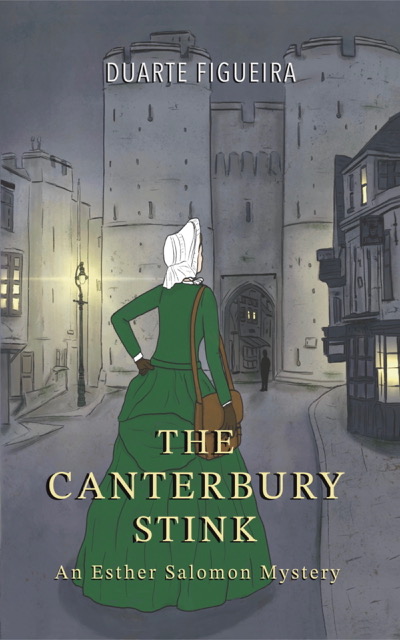
‘The Canterbury Stink’ was a conscious attempt to develop as a writer by constructing a crime plot that would carry and entertain a reader over 100,000 words. The novel is set in a fetid, cholera-ridden and corrupt 19th century Canterbury where a woman detective seeks to solve a murder everyone else would rather forget. Luckily, there are also a few laughs.
My first book, ‘The Ginger Flic Casebook’ had linked together about a dozen short story ‘cases’ in the style of a Sherlock Holmes collection and was deliberately surreal and madcap. You can fly by the seat of your pants for that, but does that work for a single long tale? Was I a ‘plotter’ or ‘pantser’? My answer was definitely plotter. I had to have the structure in my head and on paper, even if only to diverge from it. It’s far too long a trek to travel without a map.
But I discovered that with such a map two things can occur. First, there will be at least one point at which you are becalmed and then panic as you gradually slip under the swamp water. Somewhere inside your writing self, you’ve lost confidence in the map. For me, it happened when I finally brought the three main characters together – detective Esther Salomon, philosopher Karl Marx and sensation novelist Amy Price. Previously, they had each separately displayed their point of view – now one of them had to lead the reader through each chapter. Ahh, hadn’t thought of that.
I recall that Andrew Miller, discussing his new novel ‘Land in Winter’ at the Faversham Literary Festival this year, talked about letting writing ‘unspool’ itself until you start looking for an ‘escape hatch’ to finish the thing. Clearly he is a pantser. And it’s true that your trusty guide can suddenly turn from security blanket to a lead weight. You also need to be able to act on instinct to move on. So be a bit of a ‘pantser’.
Second, the bloody map will have mistakes in it, points at which you will discover that some event could not have occurred when you’d planned it, or when a character turns out to be very different to what you’d imagined. So a key landmark will turn into a mirage. Of course it would. After all, no one has ever been to that place you are creating before. So scribble the revised fiction on the map and keep going.
It is a truism that with each novel a writer reveals him/herself, and most of all to themselves. I discovered that I love the past and the way its tendrils connect to the present. The fact that water and its treatment are a real problem in Britain today has its roots in decisions about sewerage treatment made in the 19th century. As I write these words, people in Chestfield are experiencing the same disgust at the air stink they are breathing in as Canterbury folk did a century and a half ago. Though hopefully today they will not topple over with typhoid or cholera from drinking polluted water.
Why write this novel at all? Firstly, the Victorian age lives with us daily, in architecture, art and material life. To my mind, we are like Anglo-Saxon peasants living in the ruins of Roman London, reusing its city wall stones for their own purposes and wondering how the Romans ever built their amazing world. For much of the social progress we take for granted began in Victorian times, in greater democracy, in working-class political organisation and in the women’s movement, as well as in the engineering infrastructure that makes our lives easier. But in historical terms, that was only minutes ago, which reminds us that it could all be taken away.
Which brings me to Marxism and historical materialism. The germ of the novel was discovering that Karl Marx visited Margate in March 1866 to be treated for boils on his nether regions. Yet for some reason best known to himself he decided one day to walk the 17 miles to Canterbury and stay there overnight. He must have been in agony. Wondering why he did so ended up with investigation of his personal life, discovering about Canterbury’s colourful Victorian past, researching financial scandals (that then as now suffer no punishment) and reading a slew of 19th century ‘sensation’ and crime novels. At the end of it, I certainly saw where Marx was coming from in his analysis of society. The real point is that every writer needs that initial spark of interest to get the project rolling.
At the end of it I’m very conscious the novel is imperfect in many ways. But equally sure it’s a step forward for me as a writer. And I’m very grateful to WOW members for their help on that journey. And in particular to Lin White for her excellent comments, editing and ebook and paperback formatting assistance.
Available now: The Canterbury Stink by Duarte Figueira – out in paperback and on Kindle. Find it here.