Writing my second novel – ‘The Canterbury Stink’

By Duarte Figueria

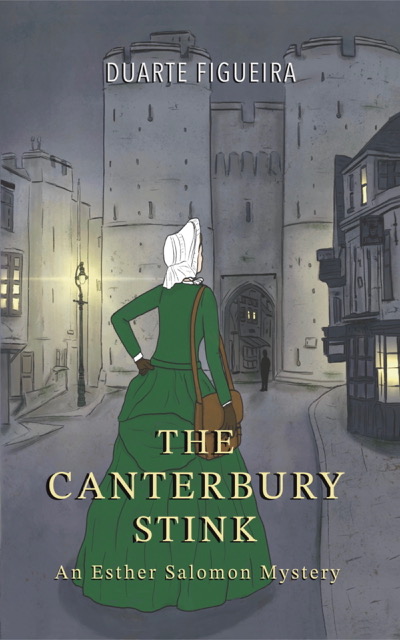
‘The Canterbury Stink’ was a conscious attempt to develop as a writer by constructing a crime plot that would carry and entertain a reader over 100,000 words. The novel is set in a fetid, cholera-ridden and corrupt 19th century Canterbury where a woman detective seeks to solve a murder everyone else would rather forget. Luckily, there are also a few laughs.

        My first book, ‘The Ginger Flic Casebook’ had linked together about a dozen short story ‘cases’ in the style of a Sherlock Holmes collection and was deliberately surreal and madcap. You can fly by the seat of your pants for that, but does that work for a single long tale? Was I a ‘plotter’ or ‘pantser’? My answer was definitely plotter. I had to have the structure in my head and on paper, even if only to diverge from it. It’s far too long a trek to travel without a map.

        But I discovered that with such a map two things can occur. First, there will be at least one point at which you are becalmed and then panic as you gradually slip under the swamp water. Somewhere inside your writing self, you’ve lost confidence in the map. For me, it happened when I finally brought the three main characters together – detective Esther Salomon, philosopher Karl Marx and sensation novelist Amy Price. Previously, they had each separately displayed their point of view – now one of them had to lead the reader through each chapter. Ahh, hadn’t thought of that.

        I recall that Andrew Miller, discussing his new novel ‘Land in Winter’ at the Faversham Literary Festival this year, talked about letting writing ‘unspool’ itself until you start looking for an ‘escape hatch’ to finish the thing. Clearly he is a pantser. And it’s true that your trusty guide can suddenly turn from security blanket to a lead weight. You also need to be able to act on instinct to move on. So be a bit of a ‘pantser’.

        Second, the bloody map will have mistakes in it, points at which you will discover that some event could not have occurred when you’d planned it, or when a character turns out to be very different to what you’d imagined. So a key landmark will turn into a mirage. Of course it would. After all, no one has ever been to that place you are creating before. So scribble the revised fiction on the map and keep going.

        It is a truism that with each novel a writer reveals him/herself, and most of all to themselves. I discovered that I love the past and the way its tendrils connect to the present. The fact that water and its treatment are a real problem in Britain today has its roots in decisions about sewerage treatment made in the 19th century. As I write these words, people in Chestfield are experiencing the same disgust at the air stink they are breathing in as Canterbury folk did a century and a half ago. Though hopefully today they will not topple over with typhoid or cholera from drinking polluted water.

        Why write this novel at all? Firstly, the Victorian age lives with us daily, in architecture, art and material life. To my mind, we are like Anglo-Saxon peasants living in the ruins of Roman London, reusing its city wall stones for their own purposes and wondering how the Romans ever built their amazing world. For much of the social progress we take for granted began in Victorian times, in greater democracy, in working-class political organisation and in the women’s movement, as well as in the engineering infrastructure that makes our lives easier. But in historical terms, that was only minutes ago, which reminds us that it could all be taken away.

        Which brings me to Marxism and historical materialism. The germ of the novel was discovering that Karl Marx visited Margate in March 1866 to be treated for boils on his nether regions. Yet for some reason best known to himself he decided one day to walk the 17 miles to Canterbury and stay there overnight. He must have been in agony. Wondering why he did so ended up with investigation of his personal life, discovering about Canterbury’s colourful Victorian past, researching financial scandals (that then as now suffer no punishment) and reading a slew of 19th century ‘sensation’ and crime novels. At the end of it, I certainly saw where Marx was coming from in his analysis of society. The real point is that every writer needs that initial spark of interest to get the project rolling.

        At the end of it I’m very conscious the novel is imperfect in many ways. But equally sure it’s a step forward for me as a writer. And I’m very grateful to WOW members for their help on that journey. And in particular to Lin White for her excellent comments, editing and ebook and paperback formatting assistance.

Available now: The Canterbury Stink by Duarte Figueira – out in paperback and on Kindle. Find it here.

Posthumous novel by WoW’s R.J. “Harry” Harrison published

Much-loved WoW member, Harry Harrison, died in November 2023. He’d workshopped his novel, ‘The Welfare’ through the group’s meetings for well over a year. We were close to reading the ending, and looking forward to seeing how the story played out. It was a massive shock when Harry was diagnosed with leukaemia and told it was untreatable.
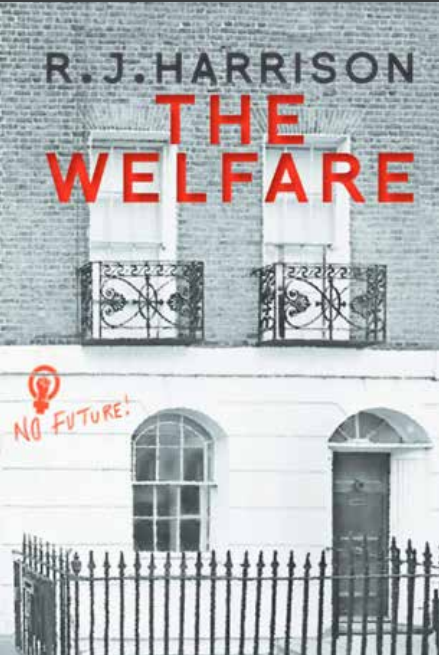
Harry had just a few months left, but wanted his book finished and published. He couldn’t manage that himself, and WoW members wanted to help. So, despite being extremely unwell, Harry put together a plan. It was a testament to his determination and character that, despite his ill health, he created a thoughtful and detailed plan of action to make it as easy as possible for the group to finish his book. We all agreed to help because the book was so good it deserved to be enjoyed by a wider readership. 

Harry determined that Richard, who has a wonderful writing style, similar to his own, would finish the last two chapters based on his notes. Duarte and Nick would edit the manuscript. Lin, of Coinlea Publishing Support, would proofread the manuscript. He gave me contact details for a publisher and friends with knowledge of the business, plus people who might help promote the book. He had ideas for the book’s cover, and as a keen member of Jericho Writers he asked on the forums how to improve the novel’s blurb. As his health was failing, he even dictated words from his hospital bed. This book meant so much to Harry.

The novel draws on Harry’s 50-year career in social work. The Welfare is set against the backdrop of 1970s London, and follows Jack Wilson, a young social worker who leaves behind his rural upbringing to navigate the challenges of life in the capital. Jack faces complex clients, office politics, and a romance that changes everything. The story is told with warmth and honesty. It’s an insightful look at the challenges and triumphs of social work, but also a poignant and entertaining story. WoW are delighted that this story will now gain a wider readership.

Thanks to Richard White, Duarte Figueira, Nick Sweeney and Lin White, for devoting so much time and effort to making this happen. I know it was a lot of work but it was certainly a wonderful way to honour a friend.

The book is available to order from your local or online bookshop. You can buy The Welfare HERE.

WoW Story Craft session 1 – Problems and goals

Writers of Whitstable has launched a new Story Craft group. This discussion group will focus on various aspects of writing a novel, with a ‘homework’ exercise before each meeting. The exercises involve looking at published novels and encouraging writers to compare them with their own works-in-progress. The first meeting focused on problems, stakes, and goals—and how these are introduced in a story. Here are a few thoughts on the subject.

Doesn’t this story conflict come naturally?

Absolutely! It would be hard to set up a story without a character hitting a problem, and with no story stakes at all. A character will often have some goal to strive for, or the goal might be to preserve the status quo.

So you’ve written a story with a problem. But are the problems big enough? Do they interest the reader or make them care?  Is it a problem that can leave a lasting impact on the character’s life?

Internal vs external problems

It’s also good to consider whether your story offers the right mix of external plot problems and internal emotional problems. This mix will vary based on the genre. Some books are mostly action, adventure, and exciting plot, others are all emotional entanglements, with stirring highs and lows for the main character. Some books are a mix of the two. When you sit down to write do you have an image of your reader, and an awareness of the type of book they are expecting?

In my genre, contemporary women’s fiction, a plot problem is typically caused by an internal character problem or flaw. I love to see characters who cause their own downfall, this adds a layer of complexity to the story. Some characters seem to ‘get in their own way’ of accomplishing a goal. The central character in ‘Eleanor Oliphant Is Completely Fine’ longs for a relationship with a local musician, but everything about her awkwardness and sad coping mechanisms make the goal impossible. I think this is a great example of an internal problem.

What is an ‘Inciting Incident’?

An ‘inciting incident’ is closely linked to story problems. An ‘inciting incident’ is a key scene that hooks a reader into the story. It’s the spark that starts the story’s journey. It usually introduces the main problem or challenge a character must overcome.

In Story Craft sessions we’re going to look at a wide range of successful books. I’m fascinated to see what we come up with through this research. Is it good to have one big dramatic inciting incident? Or does it work to have a more subtle story set-up? In the hugely popular Hunger Games book there’s a big scene to set up the story problem. The central character faces one unexpected moment and she chooses to undertake a life or death challenge.

In some books the story set up is more gradual. There might be lots of little problems that lead to a much more subtle inciting incident. Think Mr Darcy’s first encounter with Elizabeth Bennett in Pride and Prejudice.

Different genres have different conventions for setting up problems at the start. It’s always useful to read and study books that are similar to your work in progress.

The ‘central question’

When we think about the set-up of problems and stakes it’s useful to consider what this means for the reader. The ‘central question’ is connected to the inciting incident. The inciting incident problem should spark a question in the reader’s mind. A big question is raised and the reader needs to care about the answer. The inciting incident might be the live-or-die brutal Hunger Games. The central question is, ‘will Katness survive?’

Problems and goals in the story set-up ideally spark lots of questions – some of which are impossible to answer. The ‘central question’ is, ‘Will Katness survive?’ The answer is… Of course she will! No way is this going to be a book with an unhappy ending! But the set-up has created a multi-layered problem that sparks lots of additional questions too… Who will die in this life and death challenge? What will happen to Katniss’ family now she’s left? How will the brutal game change her? Will the cruel rulers of this land ever change? These are big intriguing questions we can’t answer. We are sure there will be lots of surprises to come.

A test of a great story?

I’m always looking for a hack to judge the strength of story ideas. Maybe this is one? Is the surprise generated by the plot problem some sort of clue to a story’s strength? Is there a direct correlation between the number of questions sparked by the inciting incident, and the quality of a story? I’m not sure! I do know that I’ll love exploring questions like these in our new Story Craft groups.

Want to join WoW and get involved? Get in touch!