
Nick Sweeney
I speak a few foreign languages, partly through the circumstances of living in different countries. I go to France fairly often, but I sometimes think my upkeep of French is nostalgic, as it was the first practical foreign language I studied; I learned Gaelic at primary school in Dublin, and took to it and liked it, but being nine years old, I was not engaged with it once I was living in London. French opened up a world I had sensed perhaps from early exposure to foreign films or films set in foreign parts, but didn’t see clearly until I was able to name things in that world.
I was a classic latchkey kid, and spent a lot of my childhood wagging off school and watching black and white films in our empty flat, at least some of them set in locations other than the UK – at least, that’s partly where I locate my fascination with ‘the foreign’.
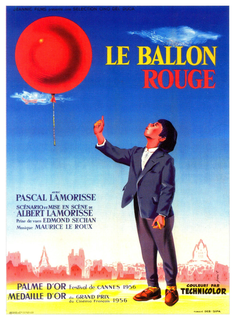
The first foreign film I remember is Albert Lamorisse’s 34-minute Le Rouge Ballon, in which a boy follows his errant balloon around the streets of Paris’ Menilmontant district. Ironically, it is more or less silent, but it instilled in me a wish to go to Paris, and live there, which I managed in the early 80s.
Language for me is primarily about speaking and listening; ice cream vendors don’t want you to write down your request for a vanilla cone using perfect spelling and grammar, nor will they write back that they only have chocolate or strawberry. I can write in French, Turkish and Polish, and also use the intriguing Cyrillic handwriting occasioned by learning Bulgarian for a year, but I wouldn’t attempt to write a novel in any of those languages.
English is, pardon the expression, my lingua franca for all my creative work. If you set your work, as I often do, in foreign countries, you have to decide how to put over on the page the fact that a character may speak in an accent. My rule is to do it as minimally as possible. Nobody wants to read excruciating pages of ah am, ow yoo zey, oon vrai Parisiann, nesspa… Point out to readers that a character has certain origins, and perhaps a few quirky phrases that accompany them, but for the love and sake of intelligibility, allow readers the leeway to work out how they perceive and process the character’s persona. Anything more is at best patronising. Years ago a member of a writers’ group I was in had set his novel in Greece, so nearly everybody in the book kept saying the few Greek phrases most tourists garner – lots of kalimera for good day, for example, and parakalo for thank you, when the ‘rules’ of writing, like them or not, dictate that every word in a novel should advance the story, even in dialogue – especially in dialogue. It was showing off, but not even particularly skilled, or useful, showing off.
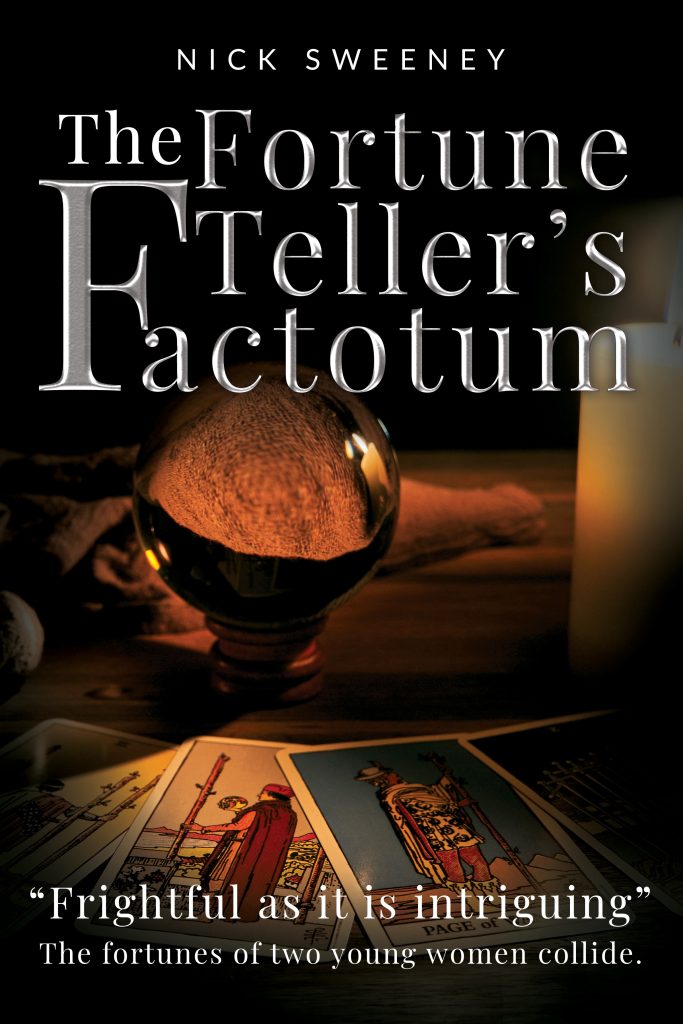
There isn’t too much to engage the foreign language spotter in my 2023 novel The Fortune Teller’s Factotum, set in Pennsylvania. Main character Ashley Hyde describes the fortune teller in the following way:
Her accent sounded almost English.
And then, perhaps 20 minutes later, after being spooked by the low lights and ‘exotic’ décor of the fortune teller’s setting, reflects that she:
…no longer sounded English to Ashley, more like somebody who had acquired English, correctly and painstakingly.
At this point we have to take Ashley’s word for it. It is revealed only in the second part of the book that the character is in fact as through-and-through an American as any American can be, but has lived overseas for over 20 years. We learn that in her twenties she abandoned her life studying at Paris’ Sorbonne on a whim and followed a Gypsy guitar player to live in the rather sinister Romania of the Ceaucescu regime. She explains:
“I never forgot English. Of course not, though I did hear of people who claimed they’d lost their native languages entirely. But I hardly spoke it. There was nobody to speak it to. Now the whole world speaks English. Badly. But not in those times. And not among the Gypsies, hardly even now.”
One of the few foreign words I use in the novel is mahala, a word I knew from Turkish to mean ‘area of a town’ but which comes from an Arabic word for settling or occupying. It corresponds to the rather un-British ‘quarter’, which goes back to the Romans splitting towns into four by criss-crossing two main roads. In Romanian, as Judith explains, it now means ‘the Gypsy Quarter’ – used neutrally, I imagine, unless its users want it to sound pejorative. A few years after I lived in Turkey, I learned Romanian for a year – the most difficult language I have set about learning – and was pleased to see plenty of words from languages I knew; the Turkish words were from the proximity of borders in the Balkans, and trade. Being a romance language, Romanian also has a lexicon familiar to any speaker of French, Italian and Spanish (but of course lots of faux amis to watch out for too). I used the word mahala in The Fortune Teller’s Factotum as a single instance of the mark Romania and the Gypsies’ own language had left on the runaway and homecomer, a small sign that just because she was away from it, and her now lost Gypsy beau, she still respected it, and found its words in her head to use.
It helps to know a language before confidently committing it to your writing, but a bit of research (and a good editor) may help if you don’t. I was amused to see this in Michael Dregni’s book about one of my heroes, Django Reinhardt:
We banged on the door, and a voice said, “Entrée!”
Were they offering an appetizer, or inviting them to come in, a reader might wonder. The word entrez might have helped.
I don’t give much credence to the much-touted ‘authenticity’ of novels; it’s an enjoyable but artificial way to tell a story. However, there are ways to make a novel less patently ‘inauthentic’, and paying close attention to people’s languages whether native or acquired, a large part of what makes them who they are, is just one of them.
Read more about The Fortune Teller’s Factoum on my website: https://www.nicksweeneywriting.com/the-fortune-tellers-factotum.html
Available from Amazon HERE.